

“Why the hell did we move so close to the beach if she never wants to go to the fucking beach?”
A male client of mine said that to me last year during a coaching conversation. He was expressing frustration with his wife and couldn’t understand why she reacted so viscerally to what he thought was such a simple, reasonable suggestion.
They’d recently moved to Mexico and were lucky enough to have found a great place close to the beach. He’d spontaneously suggested they take their kid to the beach on a Tuesday afternoon.
“Instead of being excited, she got stressed out and upset with me and refused to go.”
I’d have said the same thing ten years ago.
In 2017 my wife started talking to me about “mental load” and “invisible work.” I had no idea what she was talking about and thought she was spending too much time reading feminist propaganda.
Being a great husband has always been important to me, and I thought I was doing a fine job at it. I was doting, affectionate and her biggest cheerleader. I still try to be, and always will.
It was jarring to hear that she seemed to think I was falling short, especially because I was convinced I was excelling. My standard reaction when she brought it up was to become defensive and try to prove my case as to why she was lucky to have me and how she was better off than most of her friends.
I was the primary breadwinner while she focused on taking care of our home and being a wonderful mother to our kids. I worked hard and didn’t expect kudos or “atta boys.” In my mind, I gave her the freedom to choose how she spent her days by giving up mine.
I felt like she was being ungrateful and looking for problems where they didn’t exist. I wished she would stop filling her mind with the rantings of angry women who hated men. Instead of listening to her, I dismissed her. Many times. But she can be mighty persistent when something is important to her. It’s one of the things I love most about her and one of the things that can drive me crazy at times.
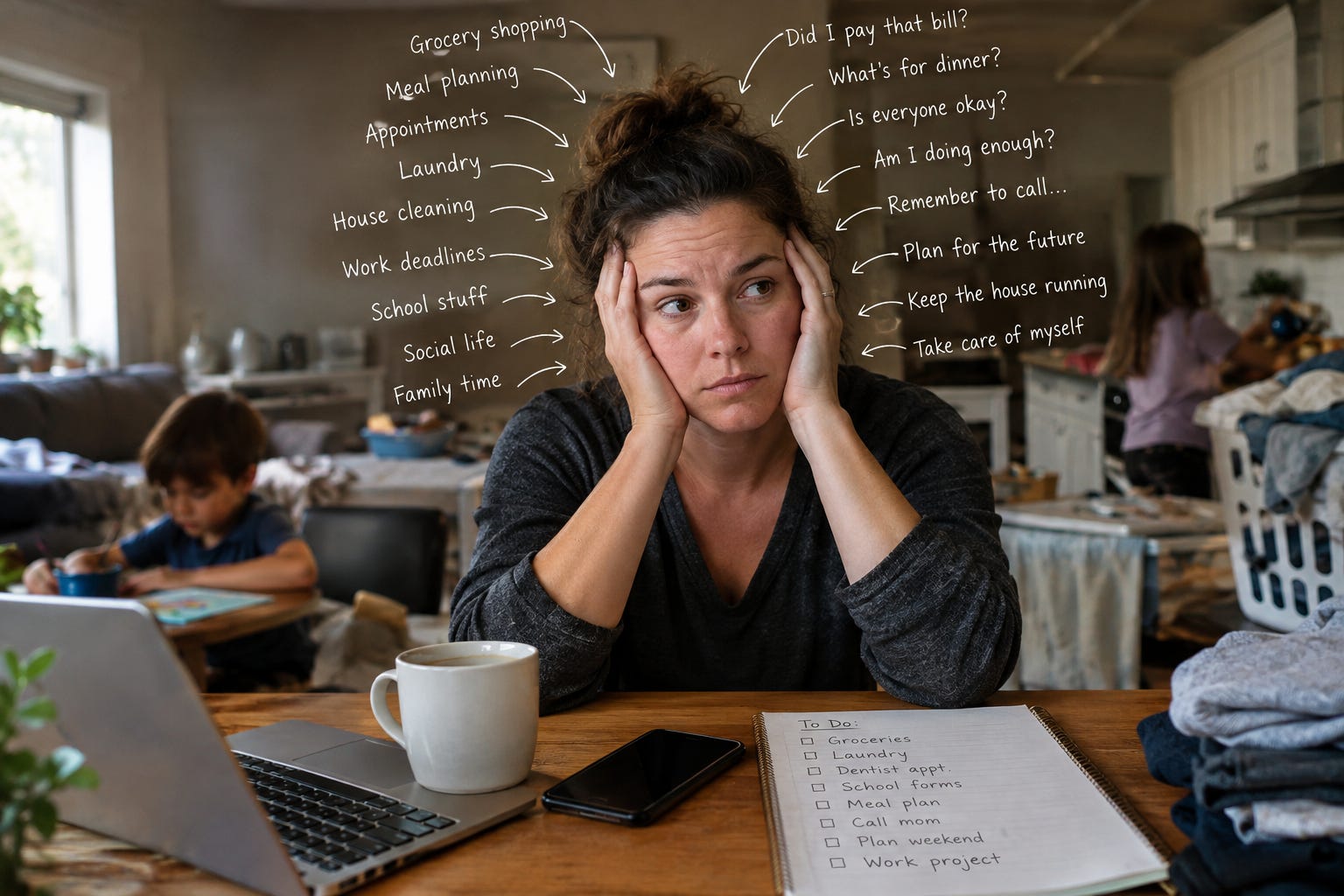
She wanted us to read a book called Fed Up together. It was the last thing I wanted to do. Gemma Hartley’s book explores emotional labour, the invisible work of remembering, planning, and managing everyone’s needs and feelings so a household runs smoothly. Because that work happens in her head rather than in visible tasks, even asking a partner for “help” leaves her as the manager.
My reaction was one word. Yuck.
Her persistence ended up breaking down my will to resist and I decided the least I could do is read it. If I was a good husband, and this was so important to her, the only right thing to do was to force myself to choke it down.
I downloaded the book and started listening to it on my walks to work. You know, the same work that I thought made me a hero and represented the sum total of my contribution to our family.
I didn’t agree with the author about everything. But as I listened to the book, my mind started to change. Through her words and conversations with my wife I gained a new, much deeper appreciation for the female experience in relationships. I realized how many things she thinks about and manages to keep our lives running smoothly that never crossed my mind. I didn’t notice or appreciate them because, until then, she’d never spelled them out one by one.
It was much more than noticing when we’re running low on milk, toilet paper, or dish soap before it runs out. She remembered the birthdays and anniversaries, and bought the gifts and the cards. She booked the kids’ dental and doctor’s appointments. She planned our holidays. She remembered when the furnace filter needs replacing. She maintained our social relationships, including with my parents.
And all that barely scratches the surface of the important tasks I was oblivious to.
She noticed our daughter’s eating disorder, long before I was able to see it, and arranged her treatment. She might very well have saved her life.
The book opened my eyes to her experience and the dynamics in our relationship. It changed how I think about showing up as a man and a partner. It helped me develop more empathy for her and for women in general. It made me a better guy and to this day I’m grateful for it.
Almost ten years on, she’ll still occasionally bring up how glad she is that we read it together and how much it’s changed our relationship for the better.
We still don’t think about some things the same way. We’re different people. I’m never going to consider the thirty-seven variables she does when deciding what kind of bread we should buy. I can still find myself dumbfounded when she explains all the factors she weighs when making decisions as seemingly mundane as what cleaning products to use.
But I understand her much better now and contribute to our family and relationship more fully than I did before.
It’s also helped me appreciate how little the average guy understands the women in his life.
So when my client complained about the beach, I asked him to try to empathize with her. What did he think caused her to react the way she did?
“I have no clue. I guess she only wants to do things that are her idea.”
I understood why he thought the way he did because I’d been there. I explained that what he sees as a spontaneous trip to the beach, she sees as him handing her a giant list of tasks she wasn’t prepared to take on.
Without warning, and without being asked, she’s now expected to consider:
What time is it now, and will we get there with enough of the day left to make it worth it?
Does anyone have nap time, a practice, or a birthday party today that this conflicts with?
What’s the forecast, and is there a chance of storms?
Is it too hot, too windy, or too cold for the little ones?
Are there lifeguards, and how rough is the water?
Who will be watching the kids in the water at every moment?
Where is the nearest washroom, and is it usable?
Swimsuits for everyone, and do they still fit?
Towels, a change of clothes, dry underwear, sunscreen, hats, and sunglasses
Snacks, drinks, a cooler, beach toys, chairs, and an umbrella or shade tent
A first aid kit, wipes, hand sanitizer, and garbage bags
Will we eat there, stop somewhere, or come home hungry, and what’s for dinner when we get back exhausted?
Is one of the kids getting over a cold or a bad night’s sleep?
Who will deal with the sand in the car, the house, and the bathtub, and who will wash and hang the wet towels and suits?
What did I plan to get done today that will now get pushed to tomorrow?
Does my body feel ready for a swimsuit today?
Will I actually get to relax, or will I spend the day managing everyone?
It’s not only that she now has to think about all this shit when she wasn’t ready to. It’s yet another example of the fact that her husband doesn’t get what it’s like for her. She feels alone and like the one person who is supposed to understand her can’t or won’t.
All he saw was an overreaction to a reasonable offer to do something fun.
What his wife wanted more than anything else was to feel seen, heard and safe. She wanted her husband to understand her experience and to validate it, without explaining to her why it’s wrong and how she should change it.
If he wants her to want to go to the beach, he needs to start with empathy. That doesn’t mean agreement. He doesn’t have to care about every item on that list the way she does. But somebody has to think about most of it, and it’s always her, and he needs to understand, acknowledge, and accept that.
Empathy will change how he approaches her about things like this. Instead of tossing out “Let’s go to the beach!” and waiting for her to make it happen, he could do the thinking first and come to her with a plan that’s already in motion.
I suggested that next time he consider saying something like, “I’d love to take everyone down to the beach this afternoon. I checked the weather, packed the cooler and the bags, and I’ll handle sunscreen, lifeguard duty, and getting the sand out of everything when we get home. All you need to do is decide if you want to come and relax.” That way the invitation feels like a gift rather than a new project, and she gets to say yes because she wants to, not because she’s agreeing to take on a day of work.
Lo and behold, when we next talked, he’d tried it. She happily agreed to go to the beach and thanked him for taking care of the details. He didn’t need to consider everything she might have. He needed to show her that he’d tried to understand and meet her needs without having to be instructed.
It took me a book, a lot of stubbornness, and a very insistent wife to learn that. He learned it in one trip to the beach.
OMG. I hated going to the beach with my partner because it was always a big production. Thankfully, his neurologist has forbidden him from going to the beach due to balance issues (he’s had many falls), and I have been relieved of this duty! Yay! I even wrote a Substack article on this. Anyway, the mental and physical load that woman do for their spouses/partners is real. Thanks for writing about this.
And maybe just possibly she could’ve heard his question as another way of saying “I just wanna sit on the beach and enjoy our Mexican paradise and hold your hand and watch the sunset”. Is it just that sometimes none of us see anybody else’s needs, but our own. Sometimes one life seems incompatible with any other life.