

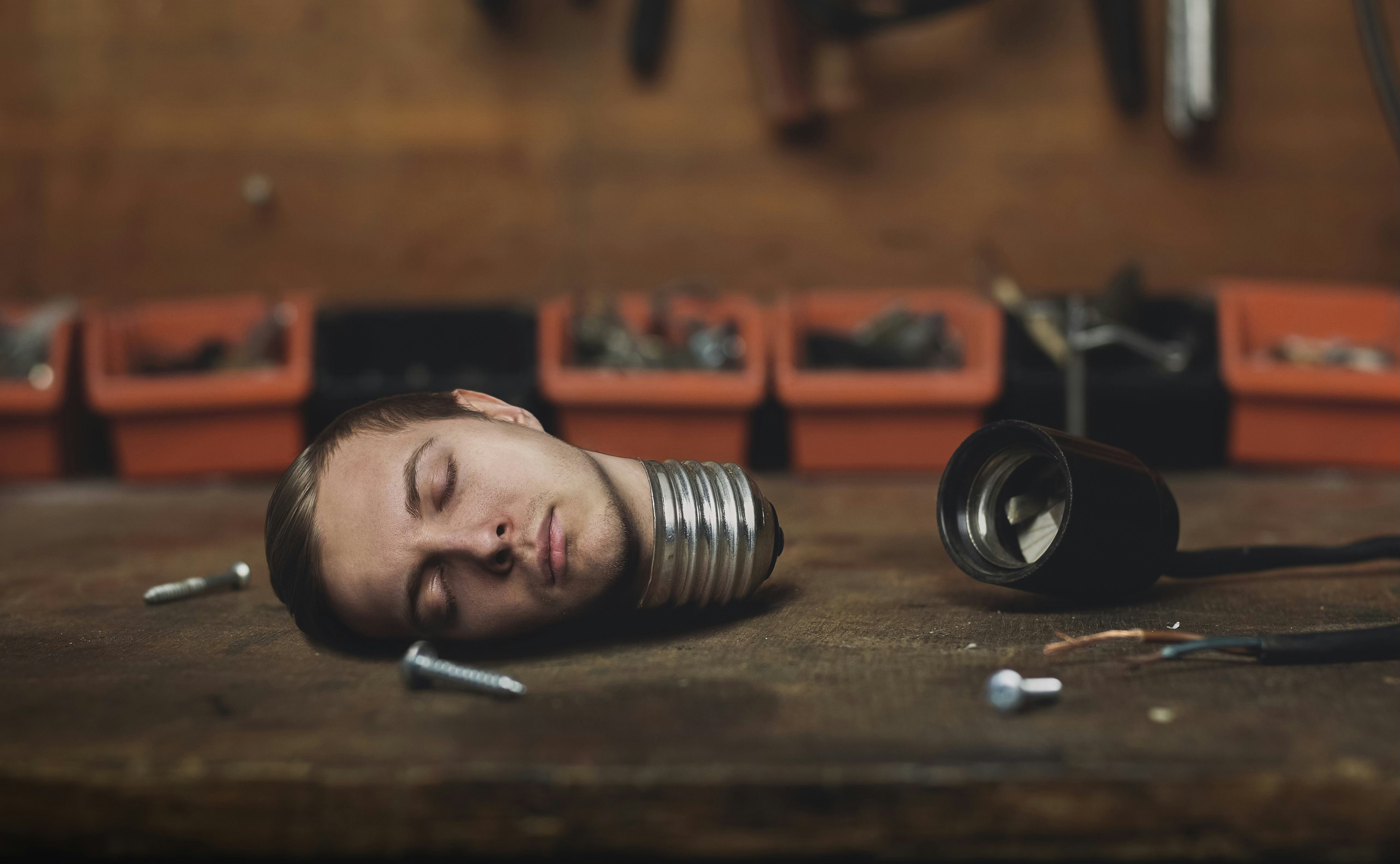
“Listen up, man. Everyone around you is on the verge of falling apart and you’re the only person holding this family together. You’ve always wondered how you’d show up when the shit hits the fan. Well, this is it. No one is coming to save you.”
Grief is hard for men to recognize because it rarely looks the way they expect. It doesn’t often look like lying on the floor in the fetal position. Quite the opposite, in fact. It looks like output. They work more hours, take on more responsibility, and stay in constant motion.
From the outside, it looks like resilience. The people around them marvel at how quickly they’ve gotten back on their feet after such a devastating loss.
It looks like leadership because it’s leaders who make decisions, keep things moving, and absorb the pressure so no one else has to.
It gets mistaken for strength. After all, only a strong man could take a hit like that and still show up every day for his family and his company.
These are the qualities that men are told make men. That’s why it goes unquestioned.
Hyper-Productivity as “Coping Well”
Productivity doesn’t just help men survive grief. It earns them approval.
The pattern is predictable. They work longer hours, take on extra projects and make themselves responsible for solving everyone else’s problems. They stay useful, decisive, and stoic because breaking down is not a fucking option.
To everyone else, this looks like strength. People say things like:
“I’m blown away at how you’re holding it together.”
“I’d never be able to do what you’re doing.”
“I hope my son never faces tragedy. But if he does, I hope he handles it just like you.”
They mean it as praise and it matters because it tells him he’s doing grief right. It feels like a lifeline preventing him from falling into a pit from when there’s no escape.
What no one says is that this version of “strength” works because it keeps the grief locked down and out of sight.
This isn’t just anecdotal.
Research on grief and stress consistently shows that men are more likely to cope through action, responsibility, and problem-solving. After loss, men are more likely to increase work hours, return to work quickly, and throw themselves into tasks. It’s not because they aren’t grieving, but because action is where they still feel functional.
In other words, this isn’t men doing grief wrong. It’s men doing grief the way they were built and trained to survive it.
Work gives the pain somewhere to go so no one else has to deal with it. Responsibility turns the pain into something people respect.
Externally, he’s performing but internally, he’s falling apart. And as long as he’s producing, no one questions what it’s costing him.
Why Action Feels Like the Only Option
Left to its own devices, grief feels everywhere at once. It’s unpredictable, invasive, and impossible to get your hands around. It crashes over you without warning and takes up more space than anything else in your life.
Action feels safer because it gives grief rules. When a man stays busy, his existence has structure. There’s a schedule to complete, a list to knock off and a next thing to handle. That structure creates predictability and predictability creates the illusion of control. At some level, he knows it’s an illusion, but it’s still miles better than the alternative.
Work is a place where effort still equals results. You do the work and something gets done. The math still works. It can feel like the only thing that still does.
That’s how grief turns into a job you never clock out of.
It’s when he stops that he realizes how exposed he is. The memories he’s been running from are right there waiting for him. The guilt, regret and helplessness overwhelm is mind and day. He’s forced to make direct contact with the exposed wire of the loss itself.
He feels out of control, like he’s failing and that everything is falling apart. So he drags himself back up off the floor and keeps moving. It doesn’t fix his grief but at least it keeps it at arm’s length for another day, hour or minute.
It feels like relief. Until it doesn’t.
Work gets him through the initial shock. Being needed is what turns it into a way of life.
Being Needed Becomes the Drug
Men don’t just work more after loss. They make themselves indispensable. They become the one who handles what the people around them can. They solve the problems, manage the details, and shoulder the burdens that no one asked them to take on.
It’s not as simple as they’re avoiding grief. Being needed gives the pain a purpose. It turns into a sense of duty. You don’t leave your position just because you’re wounded. You check the perimeter. You keep watch. You make sure everyone else gets through the night.
He’ll hold himself together so he can hold everything else together. That’s the deal with the devil he makes, often without realizing it. If I’m useful, I don’t have to be broken. Responsibility doesn’t take the pain away, but it takes the focus off it.
The problem is that he’s still carrying the weight of the loss on top of carrying everyone else. Getting back up when he takes a knee takes more and more out of him.
Eventually, his legs give out and he ends up exactly where he’s been running from.
Why Even the People Who Love Him Can’t Stop It
It’s not that no one wants him to slow down. Often, the people closest to him are desperate for it. They want him present with their pain instead of trying to outwork his own. They want him back.
But wanting him to slow down and being able to stop it are two different things.
His output is rewarded in ways that matter. Bills get paid. There’s food in the fridge. The lights stay on. He keeps things moving at work. That pressure doesn’t disappear just because someone loves him.
At home, pushing harder looks like distance.
But slowing down looks like collapse, and collapse feels like adding another tragedy to the one he’s already trying to survive.
So when the people he loves beg him to ease up, he doesn’t hear care. He hears that they don’t understand the pressure he’s under. He hears that they don’t understand he’s the one keeping the ship afloat.
When he keeps going, it’s not because he doesn’t care. It’s because this is the only way he knows how to keep everything from blowing up.
Over time, that gap turns into resentment. She feels shut out and scared she’s losing him. He feels cornered and out of options. The one thing he knows how to do isn’t working. And the world keeps rewarding his competence anyway.
So the spiral continues.
As bad as things are, stopping still feels more dangerous than pushing through.
When the Wheels Come Off
This is where the bill comes due. It doesn’t happen all at once. It’s like maxing out a credit card. At first the payments are manageable. Then the interest stacks up, and the options disappear.
Grief is the same. It shows up as exhaustion so complete that sleep doesn’t fix it and time off seems to make it worse. Everything sets him off. He snaps at people he loves and hates himself for it later.
At home, he’s there in body but his mind is a million miles away. He’s quieter, he isolates himself and seems impossible to reach. He spends more time in the garage, drunk, or doom scrolling the same stupid shit he’s watched countless times.
He was never great at expressing his emotions but now he barely registers as human. He knows something’s terribly wrong. He’s fighting a losing battle and it’s terrifying. He doesn’t know what to do about it without risking everything falling apart.
He stares at the shell of a man in the mirror and asks himself, “I’m doing everything I’m supposed to do. What the fuck is wrong with me? I’m going to lose everything.”
He’s starting to realize what he’s tried to deny for way too long. Busyness doesn’t resolve grief. It delays the reckoning. He’s forced it underground, where pressure doesn’t dissolve. It silently accumulates and always finds an exit.
When it does, it’s never pretty. It shows up in his body, his temper and the damage to his most important relationships.
When the Applause Finally Stops
At some point, and inevitably, cost becomes too great to hide and the praise runs out.
His body gives him warning signs he ignores until it won’t let him anymore. His blood pressure is through the roof, he constantly feels like he wants to puke, and his exhaustion is so total it takes everything to get out of bed.
His relationships are stretched to the breaking point. Sure, there are the dramatic blowups but it’s also the accumulation of missed moments, short answers and unspoken resentments.
He convinces himself he’s failing and the hatred directed inward always gets projected outward. Men tend to express the hard emotions as anger and that’s exactly what happens now. It gets directed at co-workers, his kids, and the people he loves most.
One day, he doesn’t recognize himself. And neither does anyone else. That’s when the language around him changes. The same behavior that was once praised as strength starts getting labeled.
He goes from being dedicated to a workaholic. Duty becomes avoidance. His resilience turns into him being emotionally shut down.
He used to be “impressive,” and now he’s a problem.
No one mentions that this is the natural outcome of exactly what he was rewarded for. No one acknowledges that the discipline, endurance, and self-denial were encouraged when they were useful.
When the applause evaporates, the expectations remain. Despite the pain he can no longer run from, he’s still supposed to perform, provide and keep his shit together.
Only now he’s doing it under suspicion instead of admiration. As if he wasn’t isolated enough before, now the only thing that kept him going is gone.
What’s left is an exhausted, confused and grieving man who’s wondering how doing everything right led him straight to hell.
Why This Pattern Feels Like Strength
Of course being hyper-productive feels like strength. Men are wired for action and trained to fix the problems in front of them. They’re taught that endurance is a virtue. They want to make things better for everyone else and God forbid they make them worse.
Hyper-production fits that rulebook perfectly. It looks disciplined, and responsible, and like a man doing what a man is supposed to do when things get hard.
There’s nothing weak about pushing through pain. Pain is weakness leaving the body, right? There’s nothing soft about putting one foot in front of the other when everything inside is screaming at you to stop.
That’s exactly why this pattern is so convincing.
It doesn’t feel like avoidance. It feels like character.
When everyone around you confirms that by praising, relying on and rewarding your effort, it becomes almost impossible to see the difference between surviving and healing.
This Was Never About Work
The turning point doesn’t have to be when he finally breaks. It can be when he recognizes the pattern.
When he finally sees that the drive to work harder wasn’t proof he was handling grief well. It was proof he was trying to survive it the only way he knew how.
That realization doesn’t have to bring shame or guilt. It can bring a monumental sense of relief. It becomes easier to see that there was never anything “wrong” with him. Relief that the exhaustion, anger, and numbness weren’t personal failures.
They were signals that all the doing had become a shield. And that healing doesn’t start with more effort, more discipline, or more grit.
It starts with understanding what all that effort was protecting him from in the first place.
It was never weakness. It was loss and the pain he never gave himself permission to face.
This is only one of the ways men get blindsided after loss. There are others, and no one warns you about them either.
I wrote a short guide that lays them out called 10 Realities Men Run Into After Loss (and No One Warns Them About)
I totally agree that this is pattern is much bigger than grief.
I think a devastating loss can exacerbate the tendency men have to spring into action. Seeking control and trying to be useful is a reaction most of us learned long before grief entered the picture.
When the pressure builds we want to remain functional and protect the people we love (even if we aren’t).
Your framing of those two moves really hits home for me. Most of us get very good at redirecting attention early on. It seems like it’s keeping a lid on the cauldron boiling over inside. And there are so many self-destructive ways to do it.
The second move can be terrifying. So many men sense that going straight at the pain could drive them straight into a pit they can never climb out of. And even if they do, they might not recognize themselves afterward.
I don’t think they avoid it simply because they’re unwilling. I think the uncertainty of where it ends up is just another thing they can’t control in a life that already seems intolerably out of control.
I appreciate how you called out the danger without dismissing the underlying fears. The tension is real and can be crippling.
And yet, it’s the only path towards healing.
I always appreciate your insights brother. 👊❤️
Thank you for this, I am not even sure how I received your email, I guess at some point I signed up for it, but this hit home in more ways than I could imagine. It has been just over 4 years since we lost our daughter, Chelsea, and I have pretty much done everything written here and wonder why I don't just sit with the grief and be present with it. Just starting to now and recently have been asked to become a mentor with the MISS Foundation, and I said yes. So now in the training I am watching videos of others loss, and I cry easily when others share their pain, but still remain stoic with my own. Anyways I guess the noticing is a step. Again thank you.